
Last Updated: November 1, 2026
Quick Summary
To solve escape room clues, search the room systematically and run every puzzle through the same loop: Look, List, Link, and Lock. Gather what seems useful, say each clue out loud, match it to a lock by format, then test your answer. Never discard a clue just because one attempt failed.
- Work clockwise from the door and check every surface at eye, waist, and floor level.
- A real clue usually connects to a lock, a puzzle, or the objective; decoration does not.
- Match clue to lock by counting characters before you test anything.
- Assign roles: a searcher, a note-keeper, and a lock-tester keep the team moving.
- Ask for a hint once you can name the specific lock you are stuck on.
Table of Contents
- How to Find Clues in an Escape Room
- A Repeatable Workflow for Solving Escape Room Clues
- Common Escape Room Puzzles and How to Solve Them
- Escape Room Team Communication Tips
- What to Do When Stuck in an Escape Room
- Book Your Team’s 60-Minute Challenge
- Frequently Asked Questions
How to Find Clues in an Escape Room
The best way to find escape room clues is to search with a system, not a scramble. Random hunting wastes minutes; a planned sweep finds hidden objects fast. Teams who slow down and search with purpose tend to outpace teams who rush.
Most missed clues are not hidden well, they are simply overlooked. Start with a deliberate pass around the room.
Search the Room Systematically
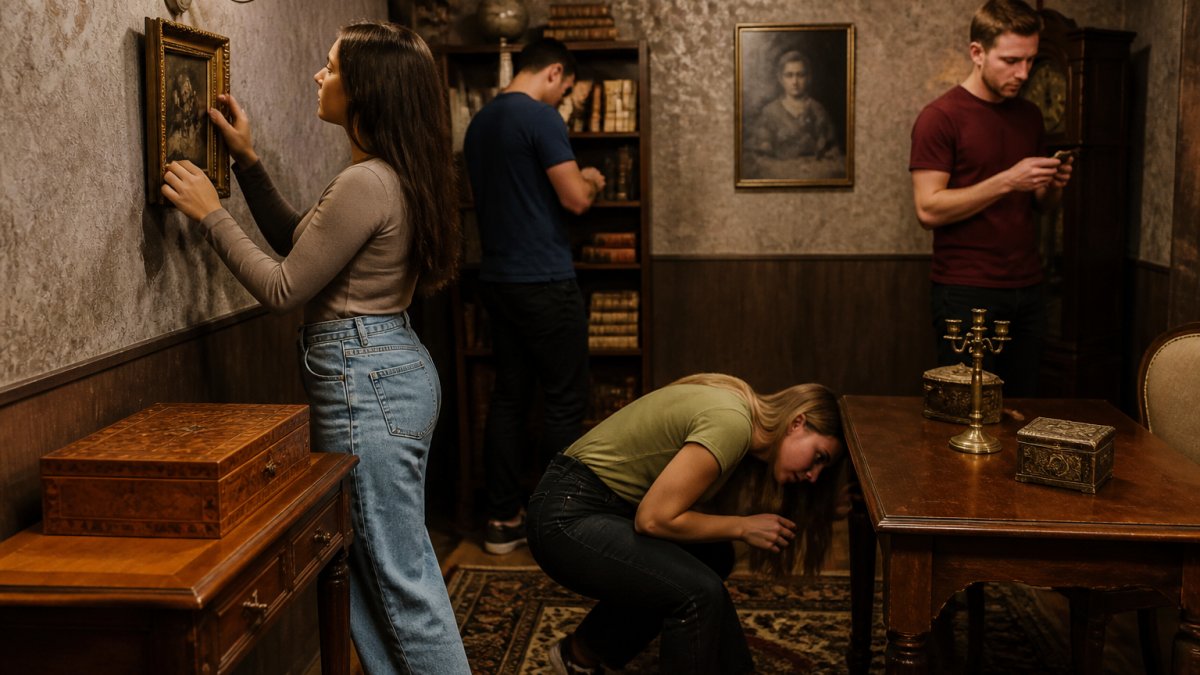
Work clockwise from the door. Check every surface at three heights: eye level, waist level, and floor level.
- Look behind frames, posters, and curtains
- Lift cushions, rugs, and loose items
- Open drawers, boxes, and cabinets
One person can call out each zone as it gets cleared, so nothing gets skipped or repeated.
Tell Useful Clues Apart From Set Dressing
Not everything in the room matters. Set dressing builds the story; a real clue usually connects to a lock, a puzzle, or the objective.
Ask three quick questions:
- Does it have numbers, letters, or symbols?
- Does it match something else in the room?
- Does it point to a lock or a hidden spot?
If yes to any, keep it. If it is just decoration, move on. A common mistake is fixating on a prop that was never meant to be solved.
A Repeatable Workflow for Solving Escape Room Clues
Every puzzle falls faster with the same loop: Look, List, Link, and Lock. It works on nearly any escape room clues you meet.
- Look. Gather everything that seems useful.
- List. Say each clue out loud and note where it came from.
- Link. Match clues to locks, symbols, or other clues.
- Lock. Test your answer on the lock or puzzle.
For example: your team finds a torn note reading “3-7-1” and a padlock with three dials. The note is the clue, the dials are the lock. Link them, then test the code. If it fails, keep the note and try the numbers in a new order.
Never throw a clue away just because one attempt failed. The clue is usually right; the order or the lock is what you got wrong.
Common Escape Room Puzzles and How to Solve Them
Most escape room puzzles fall into a few familiar types. Once you spot the type, the path to the answer gets much shorter. The table below is the quick map we share with our players, and the subsections after it walk through each family.
| Puzzle Type | What to Look For | First Move |
|---|---|---|
| Number lock | Dials or a keypad | Find matching digits nearby |
| Letter lock | A word lock or keyboard | Hunt for a hidden word |
| Cipher | Odd symbols or shifted letters | Test a simple shift first |
| Pattern puzzle | Shapes, colors, grids | Copy the pattern exactly |
| Word puzzle | Riddles, anagrams, crosswords | Say it out loud |
| Hidden object | A gap or loose panel | Search the edges and seams |
| Audio clue | A speaker, phone, or music | Listen once without talking |
Locks, Codes, and Ciphers
A combination lock needs a number sequence. Find the digits first, then work out their order. Check notes, labels, and markings on objects. If you have more digits than dials, the extras are usually a red herring or belong to a second lock.
For ciphers, try the simplest option first. A basic letter shift solves many coded messages, shift by one, then two, and watch for a readable word.
Write every candidate code on a shared note, even the ones that fail. A failed code is still data, it tells you which digits or letters are probably wrong.
Pattern, Symbol, and Word Puzzles
Pattern puzzles reward careful copying. Match the colors, shapes, or order exactly as shown. One flipped symbol can sink the whole attempt.
Symbol puzzles usually come in pairs: a symbol key somewhere in the room and a symbol lock or panel.
Word puzzles often crack the moment someone reads them aloud. Anagrams, riddles, and hidden words in text all respond to talking it through.
Audio and Hidden-Object Clues
Audio clues are the easiest to miss because teams keep talking over them. When you find a speaker, phone, or music source, stop and listen once in silence.
Hidden-object clues are about edges, not centers. Developing this keen eye for physical anomalies is the foundational skill for playing detective games, where every overlooked detail serves as a vital piece of the larger puzzle.
Matching Clues to Locks
Before you test anything, match the clue to the lock by format. Count the characters and compare them to the lock: a four-digit keypad wants four numbers, a five-letter word lock wants five letters, a symbol dial wants one symbol per position.
A common pattern is one clue per lock, plus one or two decoy clues that belong to the story rather than a puzzle. If a clue has no matching lock format anywhere, set it aside and keep moving.
Escape Room Team Communication Tips
Strong teams talk, and weak teams go quiet. Communication is the real skill behind solving escape room clues under a clock. Readers who want to improve how their group talks and listens under pressure can go deeper with this step-by-step communication guide.
- Call out what you find, even if it seems small
- Say where you found it, so others can check nearby
- Assign roles: a searcher, a note-keeper, a lock-tester
A note-keeper is worth their weight in gold. One person tracks every clue and every failed code, so the team never retries the same dead end twice.
What to Do When Stuck in an Escape Room
Getting stuck is normal, and it is not a failure. The fix is to change your approach, not to panic. Most teams lose time not because the puzzle is hard but because they keep repeating the same failed attempt.
Try these moves in order, and give each one a real try before moving to the next:
- Re-read every clue you have collected. Say each one out loud. A clue that seemed useless ten minutes ago often makes sense once a new lock appears.
- Check for an unused clue that links to the current lock. Count the characters and compare them to the lock format. If they match, you have your answer path.
- Re-test a code in a different order. The clue is usually right; the order is what you got wrong. Try reversed, sorted, or grouped digits before you abandon the clue.
- Send one person back to a spot you rushed. A second look at a single zone beats a third sweep of the whole room.
- Listen to the background sound for a hidden message. Pause the conversation for thirty seconds and let the room talk.
Do not force anything. If a drawer, panel, or prop does not open with gentle pressure, it is not meant to open that way. Forcing props is the fastest way to damage a room and get your team pulled out, and it wastes the minutes you were trying to save.
When to Ask for a Hint
Ask for a hint when you can name the specific thing you are stuck on. Readers wondering about asking for hints or how the game works can check the FAQ for rules and clue policies.
A simple decision rule: if your team has spent more than a few minutes on the same lock with no new idea, ask. If you are still generating fresh attempts, keep going.
When the hint arrives, repeat it back to the team, write it down next to the lock it refers to, and act on it immediately.
Common Mistakes That Keep Teams Stuck
- Fixating on a red herring. If a prop has no numbers, letters, symbols, or matching lock, it is probably set dressing. Leave it.
- Retrying the same failed code. Change one variable at a time, order, grouping, or which clue you are using, so you learn something from each attempt.
- Going quiet. A stuck team that stops talking stays stuck. Assign one person to keep asking, “Does anyone have a match for this?”
If you are still stuck after a hint and a reset, ask the game master whether your team has missed a clue entirely. That is a different question from “how do I solve this,” and it often unlocks the room faster.
Book Your Team’s 60-Minute Challenge
Reading about escape room clues only takes you so far. The real fun is testing your team against the clock.
You get multiple themed rooms, from haunted mysteries to sci-fi sagas, with simple pricing that includes tax. Need to add players on the day?
Ready to put these solving skills to work? Book your escape room adventure, or plan a team building event for your group.
Frequently Asked Questions
What is the trick to solving escape rooms?
There is no single trick, but the closest thing is a system. Search the room in a fixed order so nothing gets skipped, then sort every escape room clues you find into two piles: things that match a lock or puzzle, and things that don’t yet. Match items by number of digits, symbols, or colors before you start guessing. Keep one person tracking what has been tried so the group never repeats a failed combination.
How do you know which clues go together?
Match the clue to the lock, not to your gut. A four-digit combination lock needs a four-digit clue, a keypad with letters needs a word, and a directional lock needs a sequence of moves. If a clue has colors or symbols, look for a lock with the same colors or symbols. Anything that doesn’t fit an open lock yet is probably for a puzzle later in the room, so set it aside and keep moving.
What should we do when we get stuck on a puzzle?
Fresh eyes often catch what the original solver stopped seeing. Re-read the clue out loud and confirm the group agrees on what it says. If two attempts fail and nobody has a new idea, consider asking for a hint.
How should a team communicate while solving escape room clues?
Narrate what you find. Say the clue out loud, describe where it was, and announce what you are about to try before you try it. Assign one person as the clue keeper who holds unmatched items and one person who tracks attempted codes. Split the room into zones so two people aren’t searching the same drawer. Quiet groups lose time to duplicated work, so talk constantly and confirm out loud when a puzzle is solved.
The clock is ticking, and the room is waiting. Gather your sharpest teammates, bring your best communication, and put every clue to work. Book with Exit 4 Escape Rooms today and turn 60 minutes into a story your group will retell for months.
